The allure of the analogue
Overwhelm is a familiar emotion in our house at the moment. We have two young boys, a demanding musical schedule, and a nonprofit to run. Oh, and of course, the everyday joys of homeownership, taxes, chores, and grocery shopping—like everyone else. Regularly, Louisa and I turn to each other at the end of the day and say, “Oh well, we moved the needle…” We are becoming very accustomed to the feeling that every day is too short, and there is always something that must be left undone until tomorrow. With the constant time pressure of the next concert fast approaching, I am often casting around, looking for ways to improve my productivity and squeeze more out of each precious working hour.
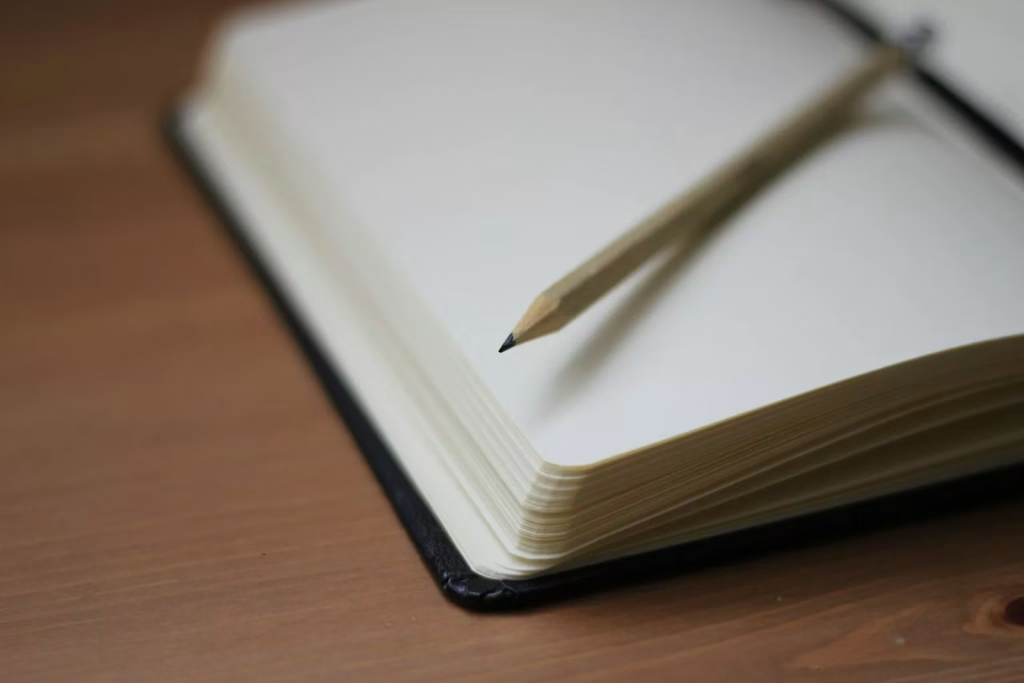
I have recently discovered that I occupy a strange place in the generational divide of today’s culture. Not content with categorizing us as belonging to the Boomers, Gen X, Millennials, or Generation Z, the culture has invented yet another sub-category. Apparently, I belong to a select subset of the working population: I am a Geriatric Millennial—born between 1980 and 1985. I am someone who, according to the zeitgeist, feels equally comfortable with the latest technology yet is not afraid of face-to-face interactions or, heaven forbid, a telephone call. For once, I actually relate to this idea. I am a bundle of contradictions. For most of my adult life, I have been an avid technology enthusiast, an early adopter, excited to try out the latest and greatest new piece of software or gadget. Recently, though, I find myself returning to the basics. After a brief flirtation with an Apple Watch, my old-fashioned timepiece is back on my wrist. After years of trying every to-do list system, digital calendar, or productivity app available, I’m back to using a blank notebook—a page for every day with a list of tasks and notes, which I review at the end of each day. Anything undone gets reviewed and moved to the next day if it still justifies the time required to complete it.
Deep down, I think we are all reaching a saturation point and starting to rebel against the digital. It is fascinating to consider just how many things have migrated into the digital space. Where once a photograph, captured on film, offered a tactile, chemical connection to the moment in time when the picture was taken, now our crisp, clear digital cameras offer something objectively “better,” yet somehow lacking the same emotional connection. There is no doubt that reading this text through a screen has less of an impact than my words would have in my own handwriting. When we receive a card in the mail, we are often deeply moved by the care and craft that have gone into sending us a message of support. The handwritten note still makes an imprint where ones and zeroes cannot.
With online streaming, we all have access to almost any film, TV show, piece of music, musical, opera, or even concert on demand, anytime. It’s all there, available right now, just waiting to be streamed… and yet, at the end of a busy working day dominated by screens, how many of us feel desperate for relief? Sometimes unlimited choice is exactly the opposite of what a precious moment of relaxation demands.
I can’t help but wonder if, deep in our subconscious, we realize we are being sold a pup. Instead of interacting with real things—the chemical process of photography connecting us with the moment in the picture, or the tactile nature of vinyl recreating the vibrations of the music recording, or even the ticking of a watch or clock marking the passage of time—we have replaced almost everything with a digital equivalent: a one or a zero. I am certain that our brains have to work harder to interpret this code, even if our senses are fooled into experiencing something that seems better, clearer, higher definition, more accurate, more sophisticated, and modern.
Perhaps the tipping point has now arrived with the mass rollout of artificial intelligence. Next month, our iPhones will be able to generate summaries of our emails or text messages. “Apple Intelligence” will happily rewrite our replies to make them “better” and will even generate images on demand to illustrate our thoughts. We will be able to remove people and other “distractions” from our photos using generative AI to replace them with perfectly synthetic backgrounds and objects. Who wants a photo of what actually happened when you can artificially “enhance” the photo to pretend you were the only ones on the beach? In theory, there is no limit to what AI could generate, given that all it has to produce is cleverly constructed code that looks or sounds “real.” So confident were the innovators at Apple of these new technological wonders that they recently released an ill-conceived ad showing a collection of analogue musical instruments, paint easels, and other creative tools being crushed in a vice, to be replaced entirely by a shiny new iPad. If you haven’t seen it, it’s worth a watch (below)…
Rather than finding all of this frightening or disturbing, though, I find myself quietly confident that in the end, all of this synthetic digital content will only serve to highlight the true value of genuinely human ideas and insights. Live classical music has an important unique selling point in this digital age: it is almost impossible to recreate the experience of a live performance through a recording. Just this week, an audience member wrote to us to share their experience of trying to listen to one of the pieces featured in our last concert on a recording. Hearing it for the first time, they “couldn’t connect with it,” only to find, in the concert, that the same piece of music swept them away: “It was exquisite!”
Just as our bodies thrive on exercise and good food, I am certain that we will soon discover that our minds thrive on analogue pursuits. The fundamental problem with AI-generated content is that it is “artificial.” And while we can fool ourselves for a while that artificial is just as good as real, our minds are like magnets for the truth. Luckily for us, of all the musical genres, only classical music has no use for digital enhancement on stage. Only the analogue vibrations from the world’s best instruments, in the hands of some of the world’s leading musicians, can create the magic of the concert experience. As one child at Franklin Elementary School excitedly related to me last week: “I could really feel the music!”
To which I replied, “Where?”
“EVERYWHERE!!!” he exclaimed. “It was sooooo nice!”
Beat that ChatGPT!